

Why Do We Need Processes?
I’m a very structured person. If I try to improvise during my workday, things can get chaotic quite fast. The same goes for big companies, like banks or insurances.
Processes are important to them because without them, things get messy and expensive: If there’s no clear structure, things get confusing, people miss steps, and a lot of time and money gets wasted.
Processes are like a roadmap, that guides everyone through the list of a task. They ensure that everyone is on the same page, knows what needs to be done, and when. This flow helps us catch any issues early, and keeps things running smoothly. In short, processes are the key to keeping our teams organized and moving forward.
Many organizations (at least here in Germany) are even required to have certain processes and document them accordingly, due to legal requirements.
Business Process Management
Business Process Management (BPM) started to take shape in the late 1990s and early 2000s when companies realized they needed a better way to manage and improve how work gets done.
Instead of doing one big overhaul of the process landscape and hoping for the best, BPM focuses on making small, ongoing improvements. It gives teams a way to look at their processes, figure out what’s working and what’s not, and keep making things better over time.
The goal is to make things smoother, faster, and less prone to errors. BPM helps businesses avoid messy workflows, fix what’s not working, and keep things running efficiently as they grow or change. It’s not just for big companies either. Even small teams benefit from having clear, well-organized processes in place.
The Process Lifecycle
At the heart of BPM is the process cycle. The idea that processes aren’t just something you set and forget. They’re meant to be discovered, designed, executed, monitored, and improved over time:
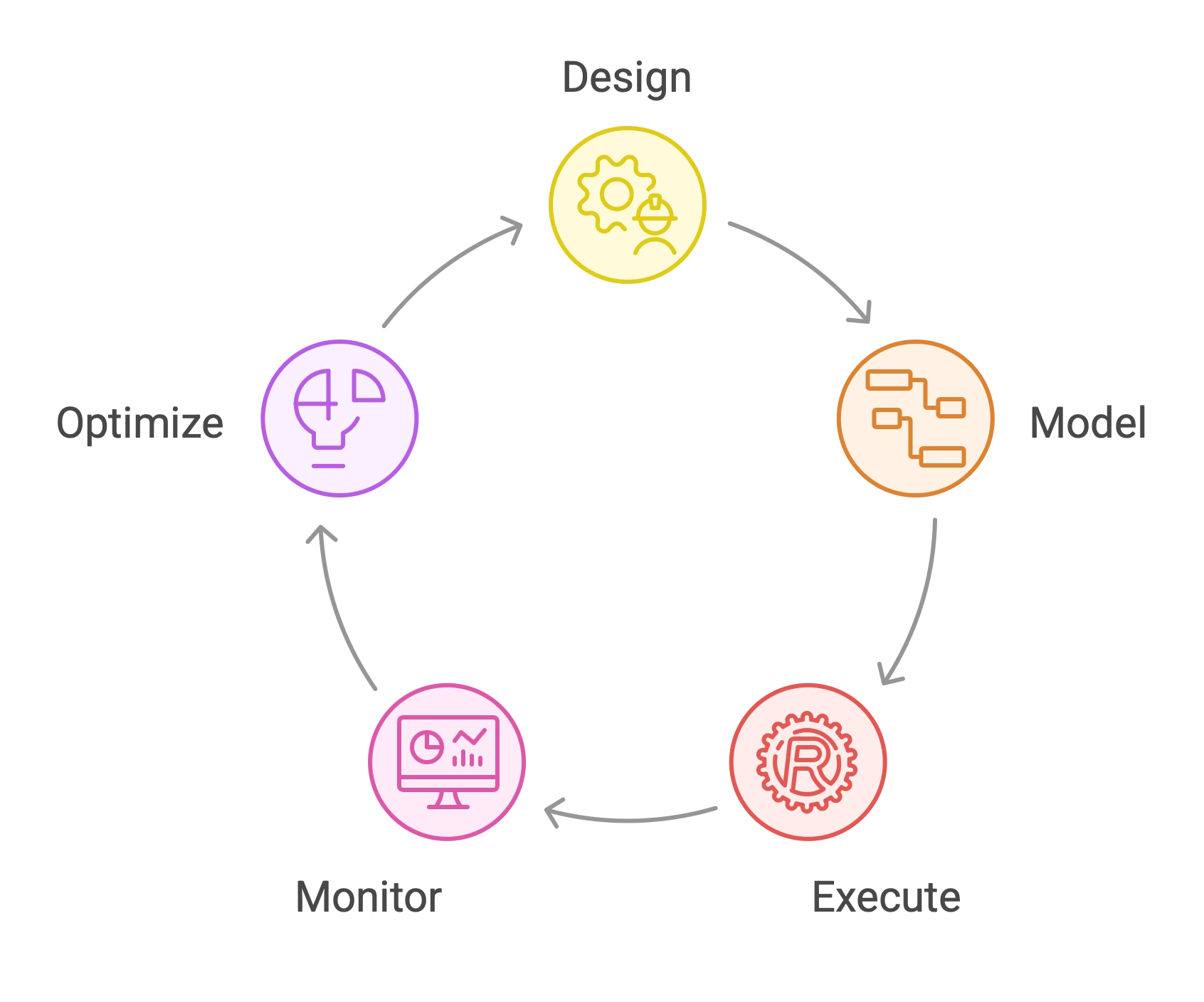
It’s a continuous cycle that helps teams keep their workflows sharp and aligned with business goals. BPM puts the process right at the center of the organization by encouraging everyone to think in terms of how work flows, not just who does what, but how everything connects and adds value.
Processes are what generates value for your organization. They are your order process bringing in revenue, your customer registration process getting people into making business with you, your onboarding process for new employees, getting them up to speed in time.
They handle your insurance claims in a timely manner, ensure credibility of business partners and make sure, you are lending the right amount of money to people and making sure it is repaid. You have to manage them accordingly.
When done well, it helps break down silos, improve collaboration, and make sure the business runs like a well-oiled machine.
Process Automation
Process Automation is a discipline inside of BPM, which deals with the execution of processes. A process model helps to understand your processes, but wouldn’t it be nice if they could be executed, and magically do all the work for you? This means that IT (with the automation tools at hand), has to understand what Business (with the process knowledge) wants, and implement each step in the process. For that, they have to align on the process’ meaning. In the industry this is what we call Business IT alignment.
It’s not as simple as it seems. Have you ever attempted to explain how to receive emails on a tablet to an elderly family member, or told your kids how to perform phone backups to ensure the safety of all their Instagram photos, just to get ignored for the 100th time?
Tech people and regular people speak totally different languages.
BPMN To The Rescue
Business Process Model and Notation (BPMN) was created to solve a pretty big problem: business people and developers needed a way to talk about processes without confusing each other. Before BPMN, diagrams were either too technical to be useful for business teams, or too vague for anyone to actually build something from them.
The first version of BPMN came out in 2004, developed by the Business Process Management Initiative (BPMI). It introduced the basic building blocks we still use today: events, activities, gateways, and the flows that connect them. Not long after, BPMI merged with the Object Management Group (OMG), and BPMN evolved further, leading to the major release of BPMN 2.0 in 2011. It became much more than just drawing. BPMN 2.0 standardized the behavior of processes, making them executable in real workflow engines.

Today, BPMN 2.0 is the standard for modeling business processes. It’s used everywhere — from simple internal workflows to large-scale enterprise automation. It’s one of the few modeling languages that actually brings business and IT together around the same table (or at least, the same diagram).
Starting next week, I will publish a series of posts about BPMN and the semantics behind the symbols. I will model a simple process and evolve it over the next weeks. When we are done, you should have a good idea about BPMN and how to use the different symbols to model different use cases.
The series starts on May, 13th 2025 and I will publish a new post every Tuesday, at 10am CEST. To mix it up a bit, I will also add some posts with a more organizational view on BPM in between.
Follow me for updates and feel free to recommend this to your friends and colleagues, who want to get into BPM and Process Automation.