

Back in May 2024, I presented some findings at CamundaCon Berlin about the Camunda Marketplace that highlighted its significant potential for both partners and customers. The marketplace provides a powerful platform where partners can showcase their expertise through connector development, and customers can access ready-made integrations to accelerate their projects. However, one key challenge emerged: customers have expressed some general concerns about using connectors, and the varying levels of quality underlines these concerns, impacting their confidence in adopting these solutions.
In this article, I revisit the marketplace to discuss how it continues to evolve, its importance in driving growth, and the opportunities it presents for both partners and customers. I’ll also analyze recent improvements and suggest ways to further enhance the marketplace, with the aim of fostering a more reliable and collaborative ecosystem.
In part 2 of this series, I’ll provide practical advice for both developers and customers on how to improve connector quality, along with examples of connectors that are already setting a high standard.
A Short Intro to Connectors and the Marketplace
A connector is a piece of business logic that you can plug into your Camunda processes to perform tasks like sending an email or interacting with another service — all without writing code. You just need to configure it properly. Camunda rolled out a Connector SDK in late 2022, offering developers early access to all the tools needed to create connectors. In 2023, they launched the marketplace, a platform where customers can find connectors for their needs and developers can share their creations with details, features, and metrics.
Feel free to check out the Camunda Marketplace and Camunda’s documentation for connectors to explore further.
How Connector Development Accelerates Growth for Partners
The marketplace is the key in Camunda’s low-code initiative, since many customers just don’t have the resources to implement their own integrations. Camunda’s connector engineering team already provides almost 50% of the connectors there. Camunda also encourage their partners to provide connectors themselves, which roughly makes the other 50% of connectors in the marketplace as of today.
This strategy is quite smart and not new to Camunda. Partners are in the centre of Camunda’s growth strategy since over a decade. There is no reason to change that now. Partners have decades of experience in the field of process automation and they know the issues of their customers and how certain integrations can solve them. And there is a lot they can gain from participating in the marketplace ecosystem:
Low Investment Costs — Camunda and the community provides lots of free tools in their GitHub repositories to develop connectors and a platform to publish them. And if you ever need support, there is great documentationavailable and a community backed forum to ask questions. Partners can use it all for free, all they have to provide is time and some good ideas.
Getting to Know Customers — The marketplace acts as a great platform for lead generation. Developing connectors allows partners to showcase their expertise directly to potential Camunda users. Additionally, well-maintained connectors can lead to direct engagements with customers, offering upsell opportunities for additional services.
Building Trust as a Partner— Developing high-quality connectors can enhance a partner’s reputation within the Camunda ecosystem, establishing them as a reliable partner. This can lead to more opportunities, since Camunda also recognizes your efforts and might put you in contact with potential clients for customizations or other feature requests.
The Quality Challenge in the Marketplace
Some partners decided quite early, that they want to leverage the marketplace for their business. Their connectors come with helpful documentation, process examples and useful tests and the repositories are updated regularly by several contributors. While these high quality connectors are a great example, they also highlight a critical challenge: they are not the norm.
The marketplace has grown rapidly, and with it, the range of quality across connectors has expanded, presenting a unique challenge for Camunda: ensuring a baseline of quality without discouraging partner contributions. With more customers using the marketplace, this is becoming more of an issue.
Customer Concerns
When Camunda asked customers about their top concerns when using marketplace connectors, the top answers were:
Compatibility with future Camunda API releases
Security and vulnerability issues
Lack of SLAs
Hidden costs by partners
Camunda handles these issues well for their own connectors, but they have little to no influence on connectors by third parties.
The Partner Connector Certification Program
To address these challenges, Camunda introduced the Partner Connector Certification Program in May 2024, which guarantees that a connector is updated regularly and that developers follow certain SLAs for bugs and vulnerabilities. The connector has to be certified every year, with every other major Camunda release. The source code has to be moved to the Camunda Community Hub, where central vulnerability scans are performed. This also means, that code ownership is transferred to Camunda.
However, no partners have certified their connectors yet. Some prefer to keep their code in their own repositories, which is understandable. Whether Camunda or the partners handle the scans, the key is that vulnerabilities have to be addressed by the partners. Camunda offers a prime spot for certified connectors, marketing them to customers, so perhaps there’s room to adjust the certification process for those already doing the work independently.
Analysis of Connector Quality
To improve, we need to look at the data. Understanding where partner connectors stand in terms of updates, testing, documentation, and other key metrics helps identify areas for improvement.
Where Do Partner Connectors Stand?
At the time of my analysis, there were 40 connectors by partners in the marketplace — 34 of which are code connectors and 6 are connector templates, that provide no code.
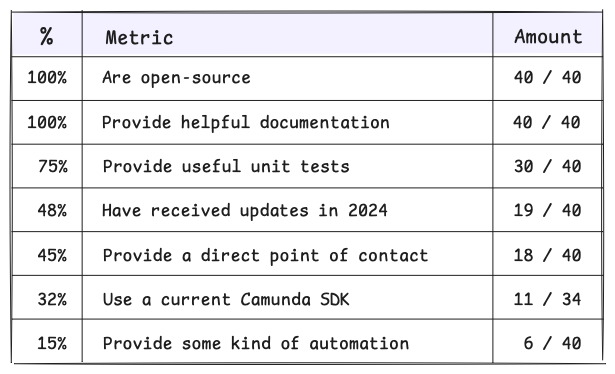
Note: Connectors using an SDK older than v8.4 are not using a current SDK. Also, the SDK version doesn’t matter for connector templates, since they don’t provide Java code, so I excluded them from this metric.
Some of these findings, e.g. the usage of old dependencies and no automation to update them, show that the customer concerns are reasonable. Half of the partner connectors might use old dependencies or could introduce vulnerabilities, and the customers might not even be able to contact the developers right away.
What Has Changed After Four Month?
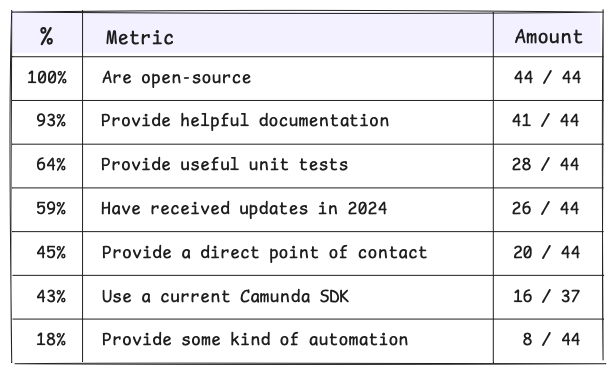
Four months later, the marketplace had 44 connectors—37 code connectors and 7 templates. In that time, 16 connectors were changed:
6 were updated
7 were added
3 have been removed
Here are the updated findings:
A Positive Trend, but Work Remains
The data analysis gives us a mixed picture of where things stand with partner connectors in the Camunda Marketplace. While we can see some good progress — like more connectors using up-to-date SDKs and more frequent updates — there are still gaps that need attention.
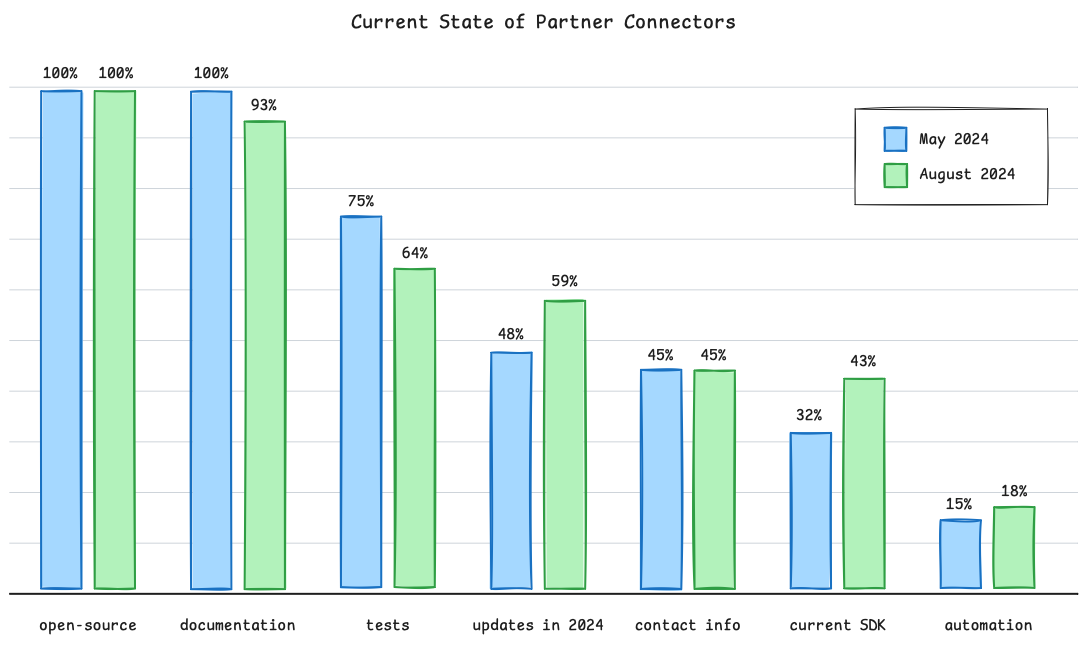
For example, the drop in documentation quality and testing, along with limited automation for test execution and dependency updates, shows that not all partners treat their connectors like the robust, pro-code products they are meant to be.
This mix of positives and negatives shows that we’re at a key point for the Camunda ecosystem. The marketplace is growing, and to keep customers happy and trusting, we need to keep raising the quality bar. So, how do we do that?
In part 2 of this series, I will provide helpful insights for partners to enhance connector development and offer guidelines to customers to ensure they can identify high-quality connectors. Furthermore, I’ll show how customers can get more involved in the quality discussion, since their feedback is vital. I will also present some good examples from partners on excellent connector development.
Appendix
Raw data can be found on my Github:
Initial data from May: https://gist.githubusercontent.com/itsmestefanjay/9f4321b659b1cff9ead904d76af11b2a/raw/67eb2dc3bed7df573b6e2aa8f48da25b828ce2ec/results_may_2024.csv
Updated data from August: https://gist.githubusercontent.com/itsmestefanjay/14fab6d5f735975bd7fa77b3a2281790/raw/17fdcd05f03cfb12a1d26c811c030980c097719d/results_august_2024.csv