

In the first part of this series, I described how partners can benefit from connector development and leveraging the Camunda Marketplace for their own growth. I presented the reader with data about the current state of partner connectors in the Marketplace: there is a positive trend in quality, but still some work remains.
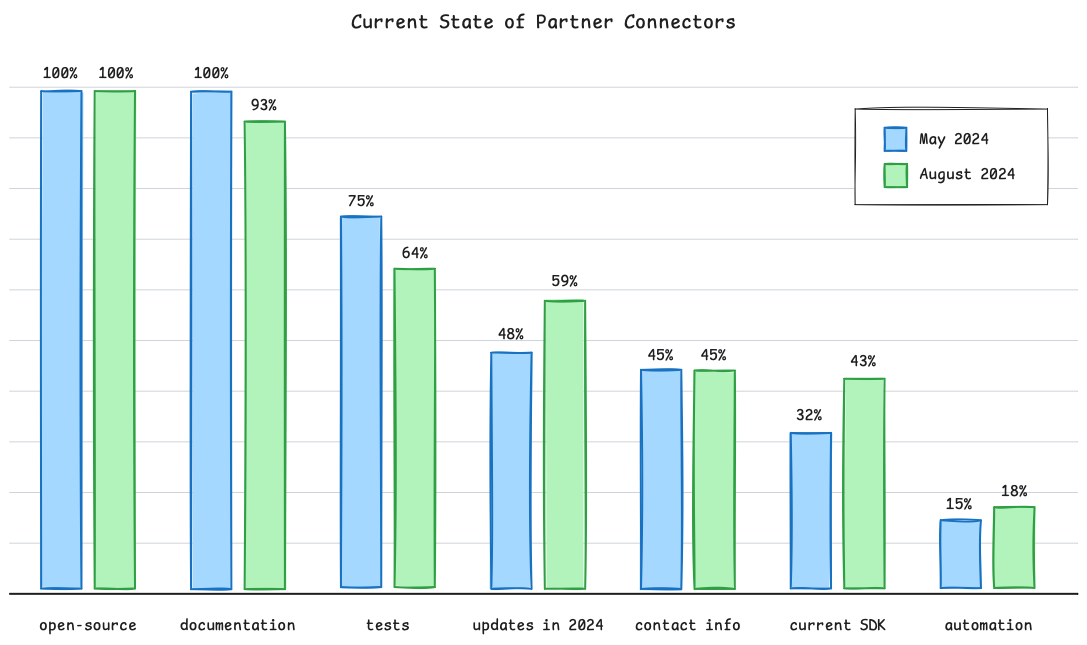
This article provides helpful insights for partners to enhance connector development and leverage the marketplace for growth, and offers some guidelines for customers to ensure they can identify high-quality connectors, which they can use in their processes.
Camunda’s Efforts And Potential Enhancements
There are already several initiatives in place to support connector quality in the Camunda Marketplace:
Free Tools and Documentation: Camunda and the community provides a lot of tools and documentation to help developers build high-quality connectors with minimal investment.
Marketplace Transparency: Information on connector compatibility and the date of the last update is openly displayed, helping customers make informed decisions.
Certification Program: This program helps highlight reliable connectors by certifying those that meet specific quality standards, offering them better visibility in the marketplace.
Developer Relations Team: Camunda has a dedicated team of experts, whose responsibility is to keep in touch with the developers of the community. They provide helpful tutorials, blog posts, code examples and more, to boost creativity and remove obstacles for developers.
Marketing Platform: Camunda highlights connectors from time to time in their blog, and lists their release in the regular developer and partner newsletters. This increases the visibility of changes in the marketplace. Furthermore, Camunda offers multiple opportunities for developers to showcase their work in Camunda Chapters and at CamundaCon.
To further enhance connector quality and partner engagement, Camunda could also consider additional steps:
Code Ownership: While certified connectors already receive prime placement in the marketplace, some partners hesitate to certify because they must move their code to the Camunda Community Hub, implicitly transferring code ownership. By providing a certification without taking over the code, could boost the count of certified connectors.
Regular Reviews for Connectors: Conducting regular reviews of all connectors in the marketplace could help ensure they maintain a high standard of quality over time. This would not only build trust but also keep the marketplace dynamic and up-to-date.
Customer Reviews: Allowing customers to leave reviews and ratings for connectors would add a layer of accountability for developers and provide valuable feedback. This transparency would help potential users gauge the reliability and quality of connectors before committing to them.
How Customers Drive Improvements
Customers have the power to decide which connector they want to use. There are some easy steps to consider, when scanning the marketplace for integrations:
Check the Connector Description: What is the last compatibility version or when was it updated the last time? This information is located on the details page and gives you a first idea about the state of the connector.
Inspect the Code Repository: See if the code does what it is supposed to do and if the repository is maintained regularly. Get help from a peer or ask the developer directly.
Check for Contributors: One problem with open-source software is, that repositories can become abandoned because the contributor just leaves it. More contributors means a lower risk.
Give Feedback: Let developers know that you plan to use their connector. Sometimes developers are not aware that you are using their connector. Raise issues for bugs or feature requests.
Certified Connectors: Make it a requirement and ask developers to certify their connector that you want to use. This way you can ensure compliance with SLAs and get regular updates.
Share Your Ideas: Use Camunda’s idea portal to submit any feature or connector requests.
Best Practices For Developers
Connector Success Stories
Some partners decided quite early, that they want to leverage the marketplace for their business. It’s encouraging to see that they are setting a high standard for connector development, demonstrating what’s possible:
Useful Code Tests: Novatec’s AWS S3 Connector for example (on which I also worked), provides integration tests, that not only test the connectors logic but also the integration with AWS.
Maximum Compatibility: The Carbon Reductor by Envite is provided for both Camunda 7 and 8 so a wide range of customers can use it.
Detailed Documentation: Holisticon provides a full set of BPM AI connectors which is an impressive showcase of bringing AI to Camunda. They have very detailed documentation and a very high commit count, showing active collaboration on the code.
Many Contributors: They all have a very active repository with more than just one contributor, which creates trust, that the repo can be maintained even if one contributor leaves. Also, they are all among the repositories with the most commits.
Template Testing: In my newest connector template for Moco, I show how json templates with custom FEEL expressions can be tested, to ensure that the underlying REST connector is called as expected.
These efforts show what’s possible when a commitment to quality is combined with the right tools and expertise. However, these examples also highlight a critical challenge: they are not the norm.
How Can You Improve Your Connector?
Apart from these prime examples and the visible upward trend in the data, there are still some developers who handle low-code connectors as something less than a real business application, even though the connectors are pro-code solutions. There must be a mind shift, to accept that a connector is real software that needs maintenance and care. If you develop a connector, consider it a pro-code product, that you provide to customers:
Test Your Code and Templates: Every time you put some logic in your connector, you increase the risk of bugs. Testing is the easiest way to ensure stability. As already shown, there are several ways to test your connector template and your code.
Automate Your Build and Test Execution: This indicates to the customer that your repository is currently useable (or not) on first glance. Use the Maven Workflow Template for GitHub Actions, there is no need to reinvent the wheel.
Keep Your Dependencies Up To Date: The older a library in your code, the higher the risk that it has vulnerabilities. Use GitHub Actions with Dependabot to update your dependencies regularly.
Enable Code Scanning: GitHub offers free tools like CodeQL to scan your code for vulnerabilities. This way you can automatically detect common vulnerabilities and coding errors.
Provide Documentation: Documentation and examples help customers to decide if your connector is the right one. Show how your connector can be used and what configuration options you offer.
Make Feedback Possible: Provide a point of contact. This can be a dedicated e-mail address, which is added to the README and the marketplace description page.
Certify Your Connector: If you already do all the things on this list, your connector should be certified easily. If you don’t, see it as a chance to improve your connector and make it more attractive for customers to use it. Check out Camunda’s certification page for more details.
By sticking to these best practices we can help the marketplace grow not just in size but in value for everyone using it.
Some Final Thoughts
The Camunda Marketplace holds great potential for customers, and partners willing to invest in connector development. As the ecosystem continues to grow, quality will be a decisive factor in winning over customers.
By committing to higher standards and leveraging opportunities like the certification program, partners can position themselves for success while significantly contributing to the health of the Camunda ecosystem.
Customers also play an important role. By actively engaging with developers and Camunda, providing feedback on connectors and asking for missing features, they can help drive improvements and ensure that their needs are met more effectively.
By working closely together, the marketplace will keep thriving and be a trusted and valuable source for integrations to different systems, in which everyone involved will benefit.