

At a talk about agentic orchestration last year, someone in the audience asked me: “Why should we use Camunda for agent orchestration when we could just use n8n?” Fair question. Both draw boxes and arrows, both call APIs, and n8n gets you a working automation in an afternoon. My answer was one word: Enterprise. What I meant is everything that only starts to matter once a process runs at volume, crosses teams and has to pass an audit.
Two weeks ago Forrester published The Forrester Wave: Adaptive Process Orchestration Software, Q3 2026. It evaluates 13 providers and names four of them Leaders, Camunda among them. Forrester’s take says Camunda “is best suited for large enterprises requiring scalable, reliable, and observable process orchestration that includes agentic AI at scale.” That sentence is pretty much the answer I tried to give in that room, only with an analyst’s name on it.
Full disclosure: I work at Consid, a Camunda partner, and I’m a Camunda Champion, so read what follows as an opinion from someone who is invested in the topic.
Two things had to come together. Camunda 8 supplied the architectural foundation, but it was already on the market when Forrester rated Camunda a Strong Performer twice. What changed is the evaluation: the new category put the properties of that foundation at the center. In my view, without the painful jump from Camunda 7 to Camunda 8, there would have been little for the new criteria to reward.
From Consultancy to Leader
Camunda started in 2008 in Berlin as a BPM consultancy, founded by Jakob Freund and Bernd Rücker. In 2013 it forked the Activiti engine and became a product company, and the fork became Camunda 7: a Java engine most teams embedded in their application, backed by a relational database. Developers loved it because the engine wasn’t hidden away: it was developer-centric and open source. Business teams loved it because BPMN was the real execution model and not a drawing next to the code.
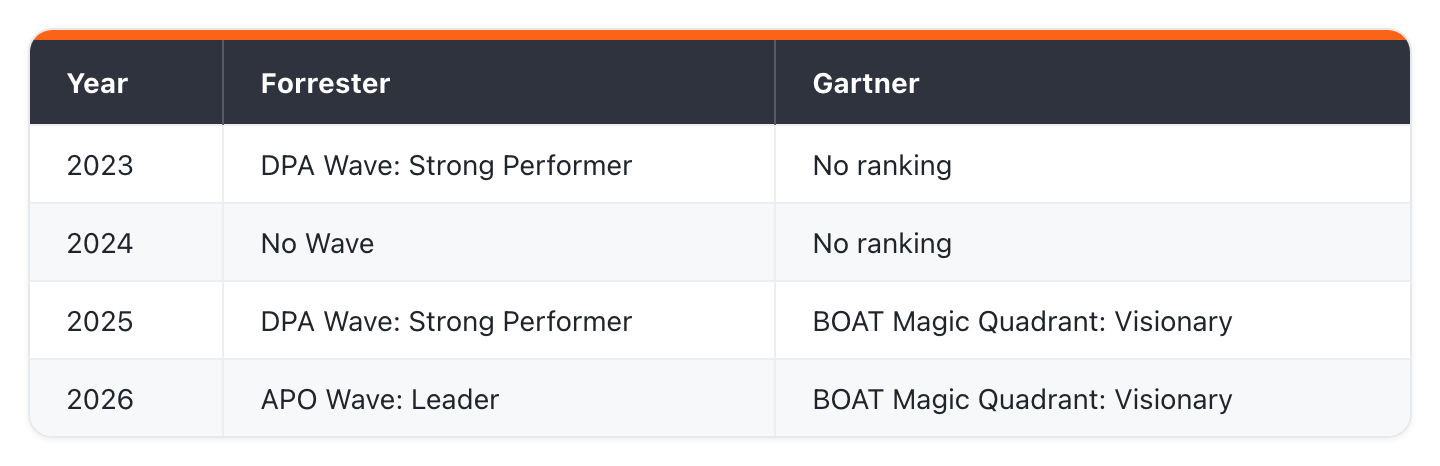
Camunda has been in Forrester’s Waves since 2023, always as a Strong Performer until this one. The first two were Digital Process Automation (DPA) Waves and the latest belongs to a different category, so read the placements as a direction across changing tests.
Q4 2023, DPA: first entry, as a Strong Performer, with top scores in six criteria including end-to-end orchestration. According to Camunda, the report already singled out Zeebe for automation at scale.
Q3 2025, DPA: Strong Performer again. Forrester wrote that Camunda suits enterprises that “require best-in-class orchestration.”
Q3 2026, Adaptive Process Orchestration (APO), a category Forrester announced in September 2025: Leader, with the highest possible scores in the architecture criteria, adoption and vision.
Camunda scored top marks on orchestration and vision in both DPA Waves and still stayed out of the Leader circle. My reading is that a DPA evaluation also weighs things Camunda never wanted to be good at, like low-code app building for citizen developers. Forrester itself wrote in the 2025 DPA Wave that the low-code promise for citizen developers “is largely overstated, with most DPA projects deployed by experienced professionals.”
Gartner started its own category in the same period. Its Magic Quadrant for Business Orchestration and Automation Technologies (BOAT), which also scores use cases like platform consolidation, placed Camunda among the Visionaries in October 2025 and again on September 14, 2026. According to Camunda, Gartner calls process orchestration its strongest capability. The methods differ too much to line up as one ranking, and I can’t say exactly why each firm landed where it did, but the pair shows that the lens matters: an evaluation built around orchestration puts Camunda in a different place than a wider one.
Why a New Category Changes the Picture
In September 2025, Bernhard Schaffrik wrote that deterministic workflow engines, RPA bots and DPA tools are not powerful enough for autonomous operations. Forrester calls autonomous operations the North Star for many enterprises, and the DPA evaluations were built around deterministic automation.
At CamundaCon Amsterdam in May 2025, Schaffrik had called for solving “the trust gap with a blend of deterministic and non-deterministic approaches.” Four months later that blend was the definition of a new market. Forrester defines APO as “an automation platform that uses AI agents and nondeterministic control flows, in addition to traditional deterministic control flows, to meet business goals, perform complex tasks, and make autonomous decisions.”
Read that definition with a BPMN model in mind. Deterministic flow around the parts that must be controlled, an ad-hoc sub-process with an AI agent inside for the parts that can’t be scripted in advance. That is the agentic orchestration Camunda shipped with 8.8, and it is what Camunda calls outer and inner orchestration: BPMN coordinates agents, people and systems, and inside the agent it governs which tools the agent may call.
So the category followed the market, and the market moved toward the kind of platform Camunda had been building since Zeebe work started in 2017. The APO report opens on trust: companies hold back on agents because they don’t trust AI output to be reliable, and Forrester’s answer is the right architecture. The criteria that carry weight in this Wave are architecture criteria, and read as questions, they are the ones a bank’s architecture board asks before it lets an agent decide anything: how much volume the platform takes, whether it stays up while you upgrade it, and whether someone can reconstruct afterwards what the agent did and which rule allowed it.
Camunda landed right where those questions sit. Forrester rates it above par for running complex processes at scale, with top marks for reliability and adaptivity, and above par for runtime observability and optimization. It also credits the platform with strong auditability, live versioning and updates without downtime, which answers the architecture board’s three questions almost one by one. On strategy, vision and adoption get top marks, the user community stands out, and customers praise the support and a product team that is easy to reach. The weak spot is the design environment, which Forrester rates below par and sees as built for technical users, but the Wave puts most of its weight on architecture, not on how processes are drawn.
The switch reshuffled the whole field. Of the five Leaders in the 2025 DPA Wave, only Appian is a Leader in the APO Wave. Pegasystems, Salesforce and ServiceNow are Strong Performers under the new test, and IBM isn’t part of the APO Wave. Camunda is the only vendor that went from Strong Performer in DPA to Leader in APO.
Why This Needed Camunda 8
I don’t think Camunda would be a Leader in this Wave with Camunda 7. Camunda 7 runs demanding workloads and will be supported for years. The question is where its limit sits.
Camunda 7 keeps process state in a relational database. You could embed the engine or run it remotely and let workers fetch external tasks over REST, which took your code out of the engine’s JVM. Either way, every state change, every fetch-and-lock and every completion is a database transaction, and the history goes into the same database. You scale by adding engine nodes and tuning the job executor and history level, until that shared database is the limit and the one component every node depends on.
Zeebe, the engine behind Camunda 8, was started in 2017 to move that limit. It has no central database. State lives in a replicated, partitioned log, workers pull jobs over gRPC or REST, and you scale by adding partitions and brokers. That doesn’t remove limits, it moves them. Camunda launched Camunda 8 on Zeebe in April 2022, runs its SaaS on it, and in 8.8 built the Orchestration Cluster around it.
Agent workloads make that capacity matter more. In Camunda 8’s native agent pattern, the agent loop runs in the engine and each tool call activates a BPMN activity in the agent’s ad-hoc sub-process, so a busy agent adds many state changes. An agent that runs elsewhere and only calls Camunda puts less of that on the engine.
For an executive, the short version: on Camunda 7, growth eventually means a bigger, more carefully tuned central database. On Camunda 8, it means adding capacity to a distributed cluster.
The move had a price, and customers carry a large part of it. Code that ran inside the Camunda 7 engine, such as delegates and listeners, has to be reworked for Camunda 8, mostly into job workers, and the tests with it. Camunda’s migration tooling cuts that work down without removing it. Camunda 7 Community Edition got its final release on October 14, 2025. Enterprise support runs until April 2030, with paid extended support until a few years later. For teams with years of Camunda 7 code in production, that is a hard message, and I understand the frustration. Nobody has to move everything at once, though: new processes can start on Camunda 8 while the existing Camunda 7 instances run out, which is the drain-out approach in Camunda’s migration guide. As I see it, Camunda had two options: keep refining a well-loved engine whose ceiling it knew, or break with it and build for the market it expected a few years later.
Camunda’s commercial numbers point the same way. Camunda crossed $100 million in ARR in September 2024 after almost ten years, and according to its press release from August, ARR is nearing $200 million. Camunda credits enterprise customers spending more than $1 million a year and its native agentic orchestration, a Camunda 8 feature. The growth happened in the Camunda 8 era, but it doesn’t show how much of it came from the engine rather than from the agent wave, sales or a growing market, or what Camunda 7 would have earned in the same years.
That is why the bet paid off for Camunda. Whether it pays off for you is a separate question. The architecture is worth evaluating when your processes run at high volume, cross many systems and teams, have to stay up through upgrades, have to be explained to auditors, and increasingly include agents that decide steps on their own. If a few of your core processes look like that, the shift deserves a serious look. If your automation is small, local and stable, a Leader badge changes nothing, and a migration from Camunda 7 costs what it costs.
Where Camunda Is Still Building
Camunda doesn’t score top marks everywhere and it makes sense to take a closer look. Of the criteria Forrester rates as on par, three carry the most weight:
content and context intelligence
the AI agent library and discovery
orchestration testing
In my view none of them points at a weakness in the architecture. They’re the questions the whole market is still working on, because agents haven’t been in production long enough for anyone to have finished answers. Forrester used material vendors provided by July 17, 2026. Camunda 8.10 ships on October 13, and a good part of it lands right on these three points.
Testing is the hardest. A deterministic BPMN path is easy to test: you drive the process and assert on the path it took. An agent can take a different path on every run, so the test has to check whether the decision stayed inside the rules. Camunda started on this early. Since 8.9, Camunda Process Test has judge assertions: a model scores how well a process variable matches an expectation written in plain language, and the test passes above a threshold. 8.10 brings them into JSON test cases, and Camunda Hub gets a test mode that runs test cases with assertions from the modeler. What I want to see next is tests that catch the failures that matter, the wrong approval or the skipped check, reliably enough to block a release. The building blocks for that are already in the product.
Context is about what the agent knew when it decided. Here Camunda has an advantage that is easy to miss: a native agent runs inside a process instance, so the steps before it, the variables it got and the human decisions around it are already recorded by the engine. With 8.10, Operate adds the agent instance on top, with its system prompt, resolved tools, every prompt and tool call, and the model’s reasoning where the provider returns it. For an auditor that splits cleanly: the process trail, which steps ran, which tools the agent called with which inputs, and who approved what, is recorded by the engine and can be checked. The model’s displayed reasoning can’t, because it is not a complete account of why the model decided. Having both next to the process they belong to is still more than most teams can show today. What I’d like Camunda to build next is context as a managed asset: system prompts, policies and knowledge sources defined once, versioned and approved like a process model, and referenced by every agent that needs them. Camunda already handles process models that way, so the step is shorter than it sounds. The test is whether a team can show, for any agent decision, which inputs, which policy version and which tool calls led to the outcome.
Discovery is where Camunda Hub comes in. In Camunda an agent is a connector, an element template with a version, and with 8.10 the engine knows agents as definitions with their own API. At CamundaCon in May I saw Hub flag models still on old connector template versions. Through the Agent Instance API, agents built with LangGraph or CrewAI report into the same view, so Camunda doesn’t have to run every agent to see it. What I’d want next is one inventory across real deployments: every agent, its version, its owner and every process that calls it. Today that view stops at the cluster. Until an organization can answer “which processes use this agent, and who owns it” across its clusters, the gap is open, but it is an inventory on top of data Camunda already collects.
The engine work that made this placement possible is behind Camunda, and that was the hard part. What’s left is making agent governance operationally dependable, release after release. Given what 8.9 and 8.10 already brought, I’m betting Camunda gets there.
What’s Next
Camunda’s next move is ProcessOS, announced at CamundaCon in May. It leaves the closed beta with 8.10 and becomes available to all paying customers. It brings AI into how processes are discovered, designed, built and optimized, the same area where Forrester rates Camunda’s autonomous process design as on par. At CamundaCon, Camunda showed it on its own Quote to Cash process: a discovery agent queried the real systems and documented the process in under an hour, and a build agent generated the BPMN and DMN from the redesign, with approvals still enforced in BPMN. I wrote about it in May, and I’ll look at it hands-on once 8.10 is out.
Camunda 8 supplied the architecture. The APO Wave made it decisive.
The bet paid off for Camunda. Your migration case is your own assessment, and April 2030 is closer than it sounds.
Agent testing, context and discovery are where Camunda goes next, and 8.9 and 8.10 already moved on all three.
When someone asks me the n8n question again, my answer will still be one word, and now boards and architects can read an independent evaluation of what it means for agentic processes in the report Camunda offers. It won’t tell anyone whether Camunda fits their processes, and it doesn’t make n8n the wrong tool for the work it does well. The next step is showing that agents on Camunda can be tested, explained and governed as reliably as the processes around them, and with 8.9 and 8.10 that work has started.